Last month in markets
- Developed equity markets performed well in August, sending the global MSCI World Index 2.4% higher in local currency terms. Some weakening in the US dollar over the month meant that returns to sterling-based investors were slightly lower (1.8%).
- The US market returned 2% in sterling terms, driven higher by what has been an exceptional earnings announcement season. Technology and ‘AI’ related stocks were strong overall, with a notable bounce back from the software sector, however it was encouraging to see positive returns broadly spread across the market – and split evenly between value and growth indices.
- Economic data stemming from the US was also broadly positive, suggesting that the business cycle is strong. The manufacturing Purchasing Managers’ Index (‘PMI’) was revised back up slightly to 53.9 while the services PMI rose to 56.5 from the July figure of 54.6 (a figure above 50 indicating expansion).
- Elsewhere, the Japanese market also performed strongly, buoyed by the generally positive equity sentiment but also by some weakness in the yen and some reassurances from Prime Minister Takaichi, which served to dampen concerns over Japan’s fiscal position. Asian markets were also very strong with the technology heavy Taiwanese market leading the way.
- Turning to fixed income, returns from the benchmark Barclays Global Aggregate Bond Index were marginally negative over the month. This muted return does, however, hide a wide dispersion of returns, and high levels of volatility, across regions and sectors. Increased expectations of rate hikes in Japan and Europe sent their respective (10-year) bond yields lower while 30-year bond yields in several regions hit multi-year highs. In the US, the Federal Reserve saw the need to intervene at the longer end of the yield curve and succeeded in pushing yields lower by announcing plans to increase its rate of buybacks.
- The oil price rose over the month as tensions in the US/Iran conflict rose however it remained below $90pb, which was not sufficient to derail the generally positive market sentiment.
Equities
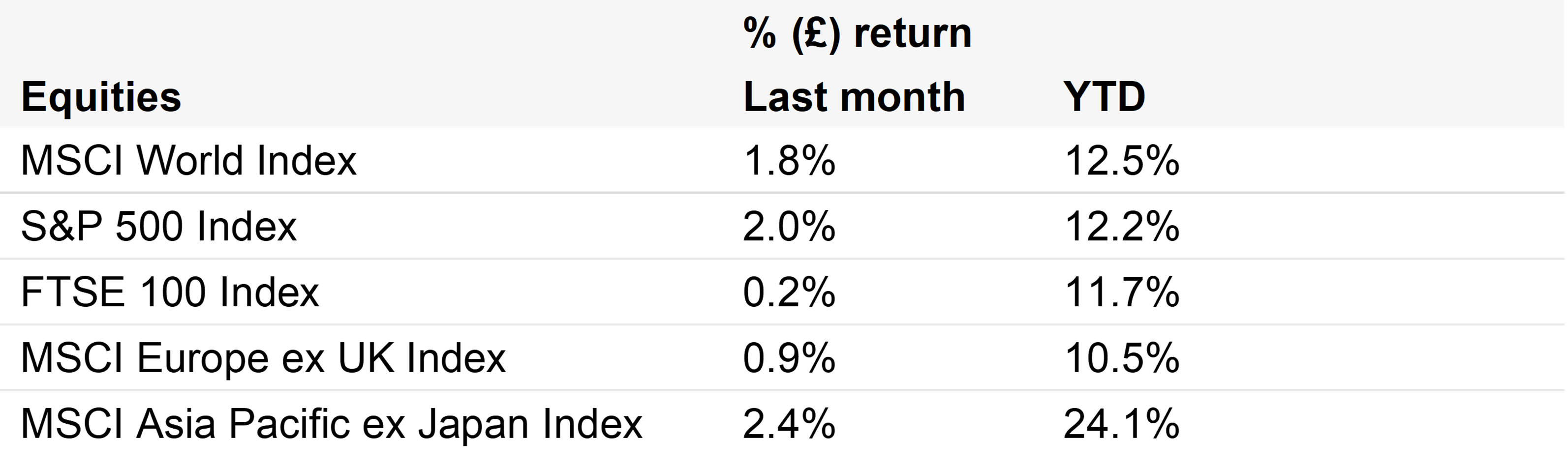
10-year government bond yields

Currencies

Source: FactSet, Morningstar and Trading Economics as at 31 August 2026. Past performance is not a guide to future results.
Rising gilt yields place fresh fiscal headwinds on Andy Burnham
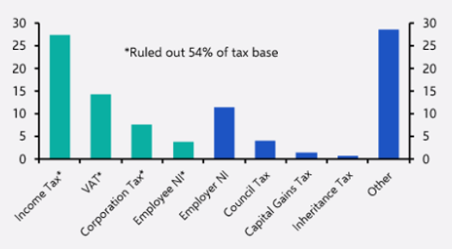
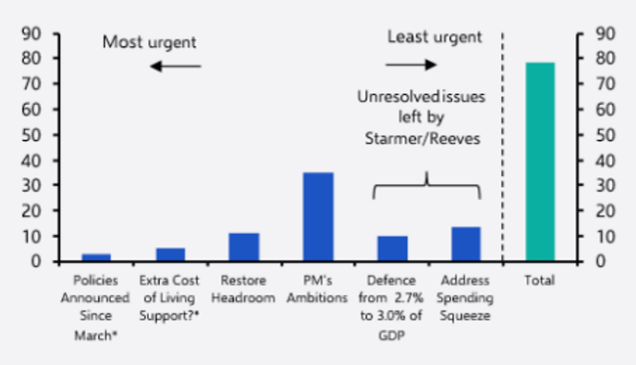
Estimates around the cost of Andy Burnham’s current policy proposals (primarily around council housebuilding, social care and the unfreezing of personal allowances) put the number somewhere around £45bn. He has said so far that he would expect to fund this using some flexibility in the fiscal rules and raising selected taxes (e.g. targeting CGT rates).
He is also burdened with outstanding commitments to provide living support, fund increases in defence spending and avoiding a squeeze in spending currently looming in 2028/9.
The recent sharp rise in UK gilt yields, which are particularly sensitive to changes in the oil price, will have further reduced his headroom (currently from £24bn to c.£15bn). This headroom may well be reduced even more by the impact of higher energy prices on UK growth and inflation, and potentially by other factors such as rising food prices if the rise in agricultural prices (up 9% over the last year) starts to impact.
Andy Burnham does have some options – potentially delaying certain pledges until after the budget or raising money by new taxes (e.g. ‘sin taxes’ on unhealthy foods or levies for sectors such as defence and social care). Or he could outright break the manifesto by perhaps raising corporation tax.
Potentially available tax revenue sources
Priority of proposed spending plans
Source: OBR, GOV.UK, Capital Economics, September 2026.
The bottom line, however, remains that he would seem to be firmly stuck in a cycle of fiscal constraint and appears to have limited tools available with which to stimulate the economy. He will also need to walk a very tight line at the forthcoming budget in terms of preserving a degree of market confidence. The bond markets will likely react poorly if borrowing is increased substantially for reasons other than investment or without a credible fiscal plan.
Given the somewhat perilous fiscal position in the UK, we have no direct exposure to UK gilts as the short-term risks remain too high in our opinion. Looking globally, we are also cautiously positioned as many of the issues highlighted above are not unique to the UK. We are therefore skewed away from sovereign bonds in our fixed income exposure and focused on higher quality and shorter-duration credit. As we have written about recently, we have also been adding to the alternatives sector, which continues to provide superior absolute returns and diversification benefits within our portfolios.
Do higher bond yields pose a risk to equity markets?
In the ‘normal’ course of events, rising bond yields should impact negatively on equity markets, as they dampen earnings, increase the risk-free rate and, in theory, push up the equity risk premium.
In recent years however this expected relationship appears to have broken down and, at the very least, moves in real yields has been an entirely unreliable forecaster of equity market performance. One explanation of this is the impact on equity markets of the huge growth in AI, both in terms of its growth expectations and actual earnings.
Looking ahead, it is certainly possible that concerns over the impact of higher yields on growth could materially impact equity markets, and especially ‘growth’ sectors, which are valued as more long-dated assets than their value counterparts. Arguably, there have already been shorter-term periods this year where this dynamic has been in evidence.
Notwithstanding this, the recent rise in yields remains relatively modest versus previous market shocks and our base case is that real yields do not rise substantially higher from here. Based on that view, we expect earnings growth to continue to be the key market driver of equity markets for a while longer. The potential impact of higher real yields does, however, further reiterate the need for diversification as market leadership may continue to broaden and oscillate in terms of style and sector.
If you would like to learn more about Bordier UK or have any questions regarding this briefing, please contact a member of the team.
This page is issued and approved by Bordier & Cie (UK) PLC (‘Bordier UK’). Incorporated in England No: 1583393, registered address 23 King Street, St James’s, London, SW1Y 6QY. The company is authorised and regulated by the Financial Conduct Authority (‘FCA’).
Bordier UK is a wealth and investment manager dedicated to providing portfolio management services. We offer Restricted advice as defined by the FCA, which means that if we make a personal recommendation of an investment solution to you, it will be from Bordier UK’s range of investment propositions and will reflect your needs and your approach to risk.
This page is not intended as an offer to acquire or dispose of any security or interest in any security. Potential investors should take their own independent advice to assess the suitability of investments. Whilst every effort has been made to ensure that the information contained in this page is correct, the directors of Bordier UK can take no responsibility for any action taken (or not taken) as a result of the matters discussed within it.