Rising oil price complicates the inflation backdrop for central banks (again)
Concerns around energy supply routes, and the recent damage to key Saudi oil infrastructure, have sent the oil price sharply higher in the last couple of weeks. These events have deepened uncertainties regarding the path of inflation and central bank policy across the globe.
As can be seen on the chart below, the rise in US inflation since the start of the conflict in the Middle East has been caused almost entirely by higher energy prices – a dynamic that has also been seen across other developed markets. Looking ahead, in addition to focusing on the shorter-term impact of higher energy prices, markets will also be closely monitoring the second-round (and potentially longer lasting) impacts to inflation. To date these have generally been more muted than feared, however there is often a lag associated with these second-round effects, which poses a material risk to any forecasts.
US CPI composition breakdown
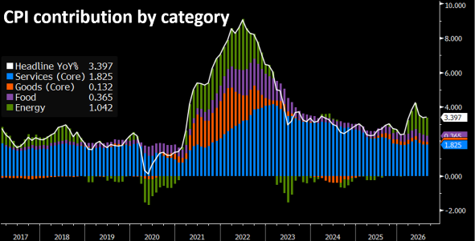
Source: R W Baird, Bloomberg, September 2026.
As was widely expected, and largely priced in by markets, the US Federal Reserve raised rates by 25bps this week, following on from a similar rise from the European Central Bank (‘ECB’) on 10 September. Market expectations are now for two further interest rate hikes in the US and c.50% chance of a further hike by the ECB next month.
The Bank of England’s (‘BoE’) decision to keep rates on hold also indicates that we should not necessarily expect central banks to act in lockstep, as they typically do in more ‘normal’ environments where central banks are often responding to the same global influence. Recent events in the Middle East have worsened the inflation outlook in the UK, as they have elsewhere. The inflation outlook has arguably moved close to the BoE’s ‘adverse’ scenario that it set out in July, which might imply some remedial action is required over the next few months. Against this, the Monetary Policy Committee acknowledged that the UK economy is relatively weak on a global scale (and isn’t enjoying the same AI-activity-related tailwind the US and parts of Asia are), while the labour market remains comparatively loose meaning wage pressures are muted. It could also be argued that UK rates were already more restrictive coming into the Iran crisis than elsewhere (especially the eurozone where rates were at 2%) so less action is now required.
There is no doubting that recent events in the Middle East have added a further layer of risk to bonds (where we remain underweight and cautiously positioned). The risks of policy mistakes are also very high – especially as the general wisdom is that supply side driven inflation shocks are often relatively temporary and are not effectively controlled by rate rises. While we may see some more modest rate rises from here in the developed world, it is also still quite possible that, if the oil price moderates, inflationary pressures could ease sufficiently for central banks such as the ECB and BoE to reverse tack at some point next year.
If you would like to learn more about Bordier UK or have any questions regarding this briefing, please contact a member of the team.
This page is issued and approved by Bordier & Cie (UK) PLC (‘Bordier UK’). Incorporated in England No: 1583393, registered address 23 King Street, St James’s, London, SW1Y 6QY. The company is authorised and regulated by the Financial Conduct Authority (‘FCA’).
Bordier UK is a wealth and investment manager dedicated to providing portfolio management services. We offer Restricted advice as defined by the FCA, which means that if we make a personal recommendation of an investment solution to you, it will be from Bordier UK’s range of investment propositions and will reflect your needs and your approach to risk.
This page is not intended as an offer to acquire or dispose of any security or interest in any security. Potential investors should take their own independent advice to assess the suitability of investments. Whilst every effort has been made to ensure that the information contained in this page is correct, the directors of Bordier UK can take no responsibility for any action taken (or not taken) as a result of the matters discussed within it.