Last month in markets
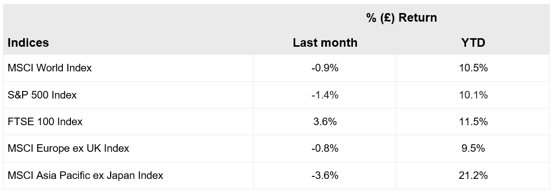
- Markets during the month of July were dominated by two separate narratives. Firstly, escalating tensions in the Middle East briefly pushed Brent Crude above $100 per barrel early in the month, lifting both energy prices and commodities.
- Secondly, as geopolitical concerns eased, investors’ attention shifted back to corporate earnings and the sustainability of returns across the AI investment cycle.
- Despite a strong Q2 earnings season, the S&P 500 Index was broadly flat over the month of July. After 63% of the index has reported, 85% of companies have exceeded analysts’ expectations, with earnings on track to grow 36% year on year. This is despite these expectations having already risen leading into the earnings season.
- For many of the largest technology companies, beating earnings forecasts was not enough to reassure markets. Investors were looking for evidence that continued increases in AI spending would lead to a return on investment.
- While some of the so-called ‘hyperscalers’ were relatively resilient, semiconductor companies and other AI names came under significant pressure as sentiment turned following a blistering rally, especially in semiconductors, in the first half of the year.
- The MSCI World Semiconductors Index fell 13.2% in July and the MSCI World Information Technology Index fell 4.1%. Value outperformed growth over the month by more than 6% due to this weakness in technology combined with strong gains in energy and financials.
- The FTSE All-Share Index outperformed most developed markets over the month, benefiting from its low exposure to technology and greater exposure to strongly performing sectors such as financials and energy.
- Asia and emerging markets were the weakest performer over the month, with the MSCI Asia ex-Japan Index falling 3.2%. Within the AI supply chain, Asian markets are more heavily exposed to semiconductor manufacturing. Names such as SK Hynix (-35%) and Samsung Electronics (-21%) took a breather over the month, having risen significantly in the first half of the year (+283% and +156% respectively), with the falls exacerbated by leveraged single stock ETFs.
- Turning to fixed income, government bond yields crept higher in the month of July as rising energy prices and resilient economic data meant investors reassessed their outlook for inflation and interest rates. Whilst central banks left interest rates on hold, there was a shift to more a hawkish narrative with markets now expecting rates to remain higher for longer and pricing in hikes over the coming 12 months.
- Looking ahead, markets are likely to remain sensitive to both energy-driven inflation risks and the sustainability of AI-related earnings. These risks reinforce our view for the need of diversification across portfolios.
Equities
10-year government bond yields

Currencies

Source: FactSet, Morningstar and Trading Economics as at 31 July 2026. Past performance is not a guide to future results.
New alternatives fund added to portfolios
As mentioned in our Q2 investment review, where relevant to the strategy, we have deployed excess cash back into alternatives, adding a new holding of the Fulcrum Diversified Core Absolute Return (‘DCAR’) fund.
Fulcrum is a specialist asset manager, operating exclusively within the alternatives space. The DCAR fund is their flagship strategy, targeting a return of cash plus 3-5% over rolling five-year periods with an equity beta of approximately 0.2.
The fund has a track record dating back to 2008, demonstrating its ability to deliver absolute returns through a wide range of market environments. During times of market turbulence, the fund has a strong track record of delivering positive returns, such as +5.5% during 2020 and +8.3% in 2022.
Discrete annual performance
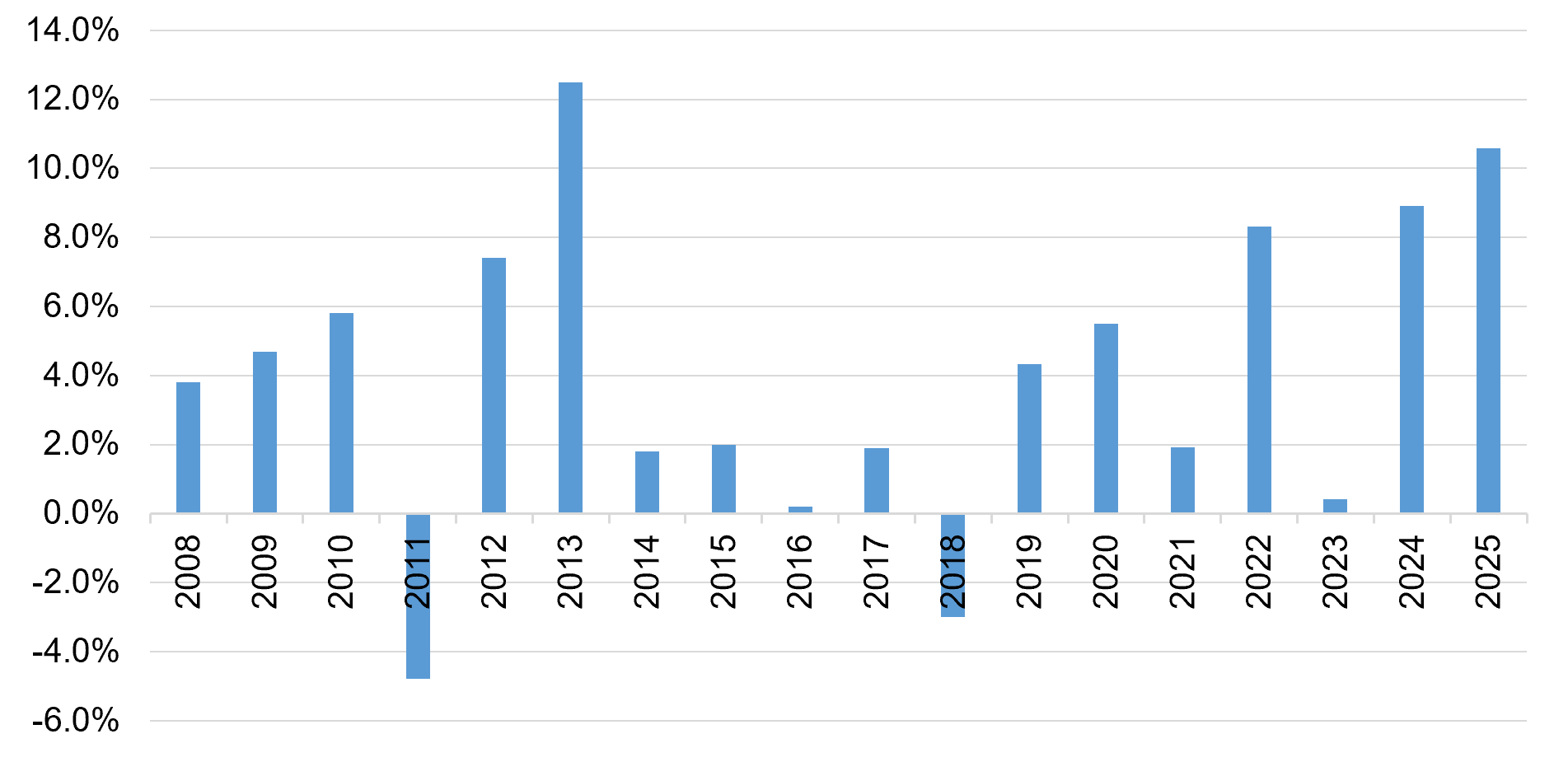
Source: The track record shown represents: 1) from 16.09.08 to 31.03.12 the Fulcrum Diversified Absolute Return strategy – source Fulcrum Asset Management LLP, 2) from 01.04.12 to 28.11.14 the TM Fulcrum Diversified Absolute Return Fund (DAR) GBP – source official third party administrator and 3) from 01.12.14 the TM Fulcrum Diversified Core Absolute Return Fund (DCAR) GBP – source official third-party administrator. TM Fulcrum Diversified Core Absolute Return Fund differs from the historic track record shown above in time periods 1 and 2 due to the exclusion of investments in third-party funds which have typically represented circa 10-20%. Aside from this, the two funds are managed on a pari passu basis. All returns are net of fees. Past performance is not a guide to future results.
The DCAR fund is a diversified macro portfolio, invested across the four liquid asset classes of equities, bonds, currencies and commodities. One of the fund’s key strategic objectives is to protect capital on the downside, using a tailored insurance overlay to help protect against extreme losses. The fund aims to avoid a 4% drawdown in any calendar month, which it has achieved in every month except one over the past 18 years.
Steady trajectory of returns with low correlation to equities and bonds
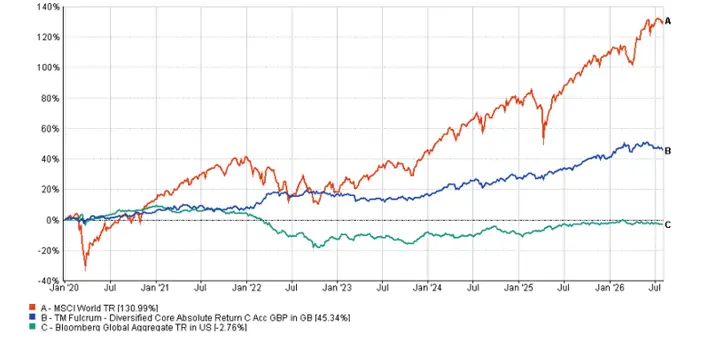
Source: FE Analytics. Data from 31 December 2019 to 31 July 2026. Past performance is not a guide to future results.
This steady trajectory of returns, low correlation to equities and bonds, and downside protection relative to traditional asset classes make this multi-strategy, macro-orientated fund a strong complement to our existing range of predominantly market-neutral funds within the alternatives universe, introducing further risk diversification.
If you would like to learn more about Bordier UK or have any questions regarding this briefing, please contact a member of the team.
This page is issued and approved by Bordier & Cie (UK) PLC (‘Bordier UK’). Incorporated in England No: 1583393, registered address 23 King Street, St James’s, London, SW1Y 6QY. The company is authorised and regulated by the Financial Conduct Authority (‘FCA’).
Bordier UK is a wealth and investment manager dedicated to providing portfolio management services. We offer Restricted advice as defined by the FCA, which means that if we make a personal recommendation of an investment solution to you, it will be from Bordier UK’s range of investment propositions and will reflect your needs and your approach to risk.
This page is not intended as an offer to acquire or dispose of any security or interest in any security. Potential investors should take their own independent advice to assess the suitability of investments. Whilst every effort has been made to ensure that the information contained in this page is correct, the directors of Bordier UK can take no responsibility for any action taken (or not taken) as a result of the matters discussed within it.