Last month in markets
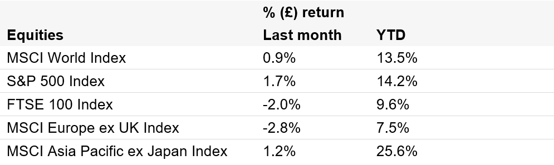
- Global equities, as measured by the MSCI World Index, fell by just under 1% in local currency terms in September. However, some strength in the US dollar versus sterling (from 1.35 to 1.32) over the month pushed this index return slightly positive in sterling terms.
- Positive returns stemmed mainly from large-cap technology and AI-related stocks while small caps generally underperformed as interest rate expectations increased. The Japanese market also continues to perform strongly, driven by a combination of earnings strength and positive corporate reform.
- Economic data continues to prove resilient. In the US, the September flash Purchasing Managers’ Indices (‘PMI’) showed the fourth successive month of expansion and rose to 58.4 (a figure above 50 indicating expansion), which is the highest figure for over five years and encompasses strength in both the services and manufacturing sector. Historically, this level of composite PMI has signalled economic growth in the region of 4%.
- The September composite PMI announcement in the eurozone was also encouraging, rising from 52.0 to 53.1, comfortably above expectations. In contrast, the UK composite PMI fell, albeit it remains in expansion territory. There was a notable decline in the services industry and in orders placed with suppliers, which declined at the highest rate for several decades.
- This broadly positive global economic backdrop, allied with continuing positive earnings growth expectations and an economic tailwind from ‘AI’ adoption/expansion, continue to provide support for equity markets.
- In terms of headwinds, further conflict escalation and supply disruption in the Middle East led to a substantial spike in oil and gas prices, fuelling fresh inflation fears, before both fell back by the end of the month. This added uncertainty, allied with the generally strong economic data, pushed interest rate expectations and bond yields substantially higher (meaning values fell).
- As was expected, the US Federal Reserve voted to increase interest rates by 25 basis points and market expectations are now for further rises in the US and eurozone, and for the Bank of England to ultimately follow suit.
Equities
10-year government bond yields

Currencies

Source: FactSet and Morningstar as at 30 September 2026. Past performance is not a guide to future results.
Investing in China
We often get asked our views on the investment opportunity in China. As the world’s second largest economy (nearly four times the size of Germany in third place), with a massive population, huge emerging middle class and broad capabilities within growing sectors such as technology, it is understandable that there would be an expectation for Chinese equities to be a key component of a global portfolio.
The reality is that, despite the Chinese economy growing far in excess of the developed world over the last decade, its equity market has been an extremely poor performer (see below).
10-year annualised returns (%)
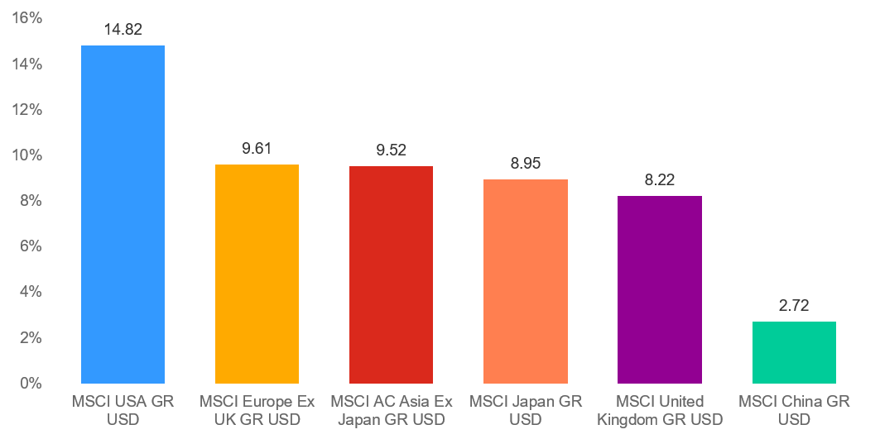
Source: Morningstar and Bordier UK as at 30 September 2026. Past performance is not a guide to future results.
Why has the Chinese equity market been so poor?
- Weak earnings growth. In terms of earnings per share (‘EPS’) the Chinese equity market has underperformed the MSCI World Index by c.7% per annum over the last decade, almost entirely explaining the c.8% annualised underperformance of the Chinese market (the rest being a slight and understandable de-rating). A well-publicised collapse in the property market has been a contributor, however weakness in the banking sector (which has suffered from failed loans to unprofitable companies, incentivised by the government) and from sectors such as industrials has also weighed heavily.
- Weak demand and over-investment/over-supply. Overall demand in China has remained relatively weak while profit margins remain very low versus other markets due to seemingly entrenched and structural issues of over-supply and over-investment, much of which has again been government driven.
Low inflation and low bond yields
- The Chinese 10-year government bond yield stands at just 1.7%, implying the expectation is for inflation to remain very depressed versus the rest of the world. China’s population is now shrinking, and productivity measures continue to fall.
- There are also structural reasons for low bond yields. Deposit rates are partially capped by China’s central bank meaning that institutions such as banks, awash with cash driven by China’s high savings ratios and compelled by capital controls to invest domestically, are being driven to buy Chinese bonds and other assets. Chinese investors also have a high degree of home bias in their equity investment, currently standing at 90%, compared to less than 40% in the UK.
What’s the view on China looking ahead?
It is true that some of the headwinds facing the Chinese equity market in recent years, such as the collapse in the property market, may have alleviated to an extent. It is also true to say that China’s export share in the global economy provides a deep and widening (if not necessarily growing) source of revenue and that the authorities continue to try to introduce reforms to ease some of the issues highlighted (with mixed success).
However, there is little hard evidence to suggest that the aforementioned structural problems of over-investment and over-supply are likely to dissipate quickly. It is also difficult to paint an overly rosy picture around demand given the current dynamics and constraints China faces.
Looking at the equity market, we expect profit margins to remain comparatively low and earnings growth expectations to remain muted, particularly versus other key Asian markets. This, allied with ongoing concerns around tensions with the US and the perceived risk of unhelpful market intervention from Chinese authorities, is likely to continue to restrict foreign capital inflows. It is interesting to note that, post the huge rise in technology stocks such as Samsung, TSMC and SK Hynix, both the Taiwanese and Korean stockmarkets are now larger than China’s.
We therefore remain cautious around allocating capital directly into the Chinese stockmarket. A far superior approach in our opinion is to invest in broader Asian funds (we remain positive on Asian equities overall), utilising selected active managers to cherry pick the gems within the Chinese market (which it certainly has) or target Chinese growth themes (such as the demand for luxury or western brands) via companies listed elsewhere.
If you would like to learn more about Bordier UK or have any questions regarding this briefing, please contact a member of the team.
This page is issued and approved by Bordier & Cie (UK) PLC (‘Bordier UK’). Incorporated in England No: 1583393, registered address 23 King Street, St James’s, London, SW1Y 6QY. The company is authorised and regulated by the Financial Conduct Authority (‘FCA’).
Bordier UK is a wealth and investment manager dedicated to providing portfolio management services. We offer Restricted advice as defined by the FCA, which means that if we make a personal recommendation of an investment solution to you, it will be from Bordier UK’s range of investment propositions and will reflect your needs and your approach to risk.
This page is not intended as an offer to acquire or dispose of any security or interest in any security. Potential investors should take their own independent advice to assess the suitability of investments. Whilst every effort has been made to ensure that the information contained in this page is correct, the directors of Bordier UK can take no responsibility for any action taken (or not taken) as a result of the matters discussed within it.