Encouraging developments on a US/Iran ceasefire
Markets have welcomed the recent news surrounding progress on the US/Iran ceasefire, and the potential reopening of the Strait of Hormuz, which has sent the oil price sharply lower to around $80pb at the time of writing.
World: Brent spot oil price
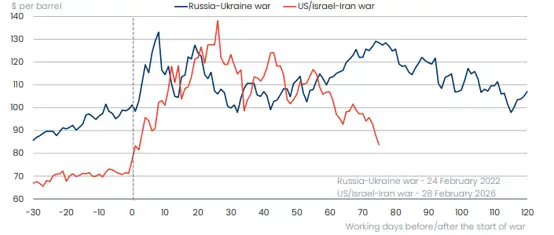
Source: Oxford Economics, Haver Analytics as at 15 June 2026.
We remain cautious, as the agreement details are still sketchy and negotiations so far seem to fall some way short of a formal signed deal. We also acknowledge that, if a firm deal is agreed, question marks remain over how quickly the current backlog/logistical issues can be fixed and what will happen in relation to important issues such as tolls and shipping insurance costs.
Nevertheless, these developments are undoubtedly positive and push expectations more firmly towards our ‘base case’ scenario, which is that the impact of the conflict will not be sufficient to lead us into a 2022-type stagflationary environment or derail the investment case for risk assets.
Central banks are facing some difficult policy decisions
Markets are now very focused on the actions of central banks over the coming months, with the key question being whether they will focus more on the (upward) inflationary impact or (negative) growth impact of the energy supply shock in their rate decisions.
The inflation outlook remains complicated, not least because there is often a lagged effect that makes shorter-term forecasts very difficult. One issue that the FT covered this week, but has not been highlighted much elsewhere, is that the impact of the oil price on inflation may be about to reverse. The argument is that once we are through this supply-side shock, we may well see a period of oil oversupply as production from the UAE rebounds and we see more production from countries such as Brazil and the US. Estimates for this extra production are in the region of $3-4m bpd and, while some countries will likely initially look to restock their own depleted reserves, this extra supply could suppress the oil price significantly and, in turn, ease inflationary pressures.
Our view is that if global economic growth remains muted for this year, and central banks gain confidence that the inflationary spike will be temporary (as has historically usually been the case for supply-driven shocks) then it may well be that we see minimal policy tightening outside of what has already been done.
Given the above, we remain well positioned in our strategies
We have maintained our equity exposure as markets push higher on the back of strong earnings growth expectations. This is complimented where appropriate by allocations to uncorrelated alternative assets and relatively modest exposure to fixed income, which is defensively positioned while inflation risks remain heightened.
This page is issued and approved by Bordier & Cie (UK) PLC (‘Bordier UK’). Incorporated in England No: 1583393, registered address 23 King Street, St James’s, London, SW1Y 6QY. The company is authorised and regulated by the Financial Conduct Authority (‘FCA’).
Bordier UK is a wealth and investment manager dedicated to providing portfolio management services. We offer Restricted advice as defined by the FCA, which means that if we make a personal recommendation of an investment solution to you, it will be from Bordier UK’s range of investment propositions and will reflect your needs and your approach to risk.
This page is not intended as an offer to acquire or dispose of any security or interest in any security. Potential investors should take their own independent advice to assess the suitability of investments. Whilst every effort has been made to ensure that the information contained in this page is correct, the directors of Bordier UK can take no responsibility for any action taken (or not taken) as a result of the matters discussed within it.