What’s driving the recent government bond sell off?
30-year government bonds in many developed countries (including the US and the UK) have recently risen to levels not seen for over 15 years.
30-year government bond yields
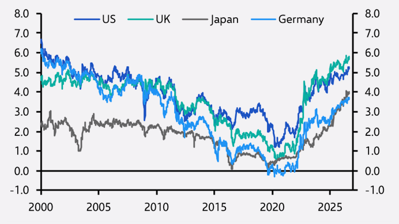
Source: LSEG data and analytics, August 2026.
In the US, this spike in yields is despite the fact that the most recent economic data has been softer, sending shorter term yields lower and dampening expectations of a September rate hike by the Federal Reserve.
It is also difficult to pin this movement in yields on the US/Iran conflict as the situation has not moved materially in recent weeks.
This therefore begs the question as to what has driven the rise in yields. The most likely reasons appear to be:
- Continued huge bond issuance from governments, combined with historically high corporate bond issuance, most notably AI-infrastructure-build-related borrowing from technology companies.
US treasury and corporate bond issuance
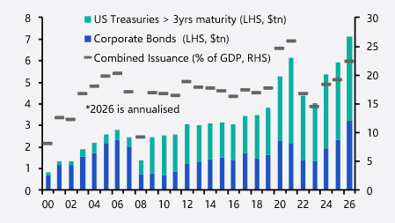
Source: LSEG data and analytics, August 2026.
- Some re-ignition of concerns over the fragile fiscal positions facing much of the developed world. Within the US, the budget shortfall for last month was $432bn, the highest monthly figure for over five years, indicating that the current administration is not focused on addressing its deficit. US debt financing for the current year is expected to be around $1.4trn, putting it third on the government’s spending requirements behind only social security and medicare. Similar concerns surround other developed economies, including the UK, France and Italy.
- Some are also arguing that the US bond market is reacting adversely to a higher degree of uncertainty driven by less communication from the new Federal Reserve Chairman Kevin Warsh, particularly in relation to forward guidance.
Our current view
Rises in 10-year government bond yields have been more modest, and the reaction of the index-linked market points to muted inflation concerns. This also suggests that the substantial rises in longer term bond yields have been driven more by over-supply and rising term premia (linked to investor caution) than by (more worrying) concerns around the ability of central banks to control inflation.
We remain cautiously positioned within fixed income and reduced our exposure in relevant strategies earlier in the year, re-deploying the proceeds more recently into a diversified multi strategy alternative fund (details of which were in our end of July publication). We are reviewing this positioning regularly however as attractive investment opportunities could present themselves if the current dynamics recede and the path of future inflation and rate policy becomes clearer.
If you would like to learn more about Bordier UK or have any questions regarding this briefing, please contact a member of the team.
This page is issued and approved by Bordier & Cie (UK) PLC (‘Bordier UK’). Incorporated in England No: 1583393, registered address 23 King Street, St James’s, London, SW1Y 6QY. The company is authorised and regulated by the Financial Conduct Authority (‘FCA’).
Bordier UK is a wealth and investment manager dedicated to providing portfolio management services. We offer Restricted advice as defined by the FCA, which means that if we make a personal recommendation of an investment solution to you, it will be from Bordier UK’s range of investment propositions and will reflect your needs and your approach to risk.
This page is not intended as an offer to acquire or dispose of any security or interest in any security. Potential investors should take their own independent advice to assess the suitability of investments. Whilst every effort has been made to ensure that the information contained in this page is correct, the directors of Bordier UK can take no responsibility for any action taken (or not taken) as a result of the matters discussed within it.