Last month in markets
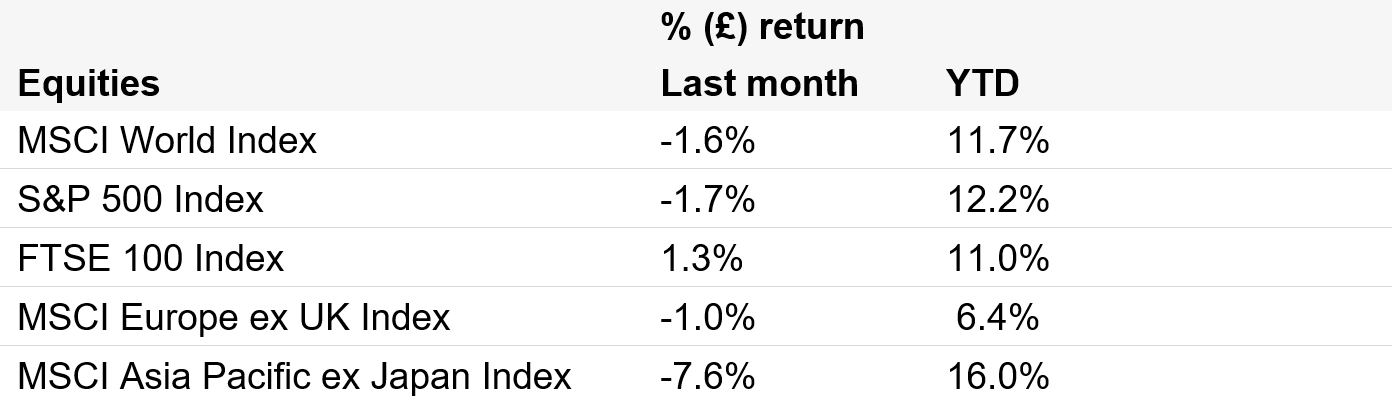
- Developed equity markets declined over October with the MSCI World Index falling 1.6% in sterling terms.
- The key dynamic within equity markets was the sharp sell-off in technology/AI-related sectors, driven by continued concerns over the extent and financing of the infrastructure buildout, as well as the sustainability of earnings in the face of increasing competition. Double-figure percentage declines were seen in some of the industry heavyweights in the US market, and across broader sectors such as semiconductors.
- Companies with high levels of borrowing were some of the hardest hit, with CoreWeave, a highly leveraged US company that develops datacentres, at the centre of these concerns. Asian markets were also severely affected by the AI-related sell-off, particularly technology-heavy markets such as Taiwan and South Korea. The surprise re-election of President Lula in Brazil caused a further market sell-off in Brazil and weighed heavily on Latin American markets generally.
- The equity market sell-off was, however, substantially confined to the technology/AI-related sectors. Sectors such as energy, consumer staples and utilities performed strongly as the market rotated to ‘value’ sectors, which outperformed their ‘growth’ counterparts by 7% over the month. This rotation also explains the relative outperformance of markets such as the UK, which has heavy weightings in traditional ‘value’ sectors and limited exposure to technology.
- The oil price rose sharply, ending the month close to its 2026 high, as tensions in the Middle East increased again. Despite this, and despite some stronger-than-expected economic data from the US and Europe, developed market government bond yields fell (meaning values rose). Regional and sector performance within fixed income was unusually divergent, however, reflecting fiscal concerns in countries such as France and the uncertainties around the scale of the ‘hyperscalers’ debt issuance and AI-financing more generally.
- Both gold and silver fell sharply, and have been poor performers so far this year – we continue to have no direct exposure.
- There were few surprises in the UK budget announcements, where the chancellor reiterated the government’s commitment to its fiscal rules, and market reaction was correspondingly muted.
Equities
10-year government bond yields

Currencies

Source: FactSet and Morningstar as at 31 October 2026. Past performance is not a guide to future results.
The Democrats sweep the US midterms
The results of the US midterm elections have given the Democrats control of Congress with Donald Trump’s Republican administration losing their majority in both the Senate and House of Representatives. The shorter-term implications of this are still being digested by markets, where the reaction has been positive so far, however the election result has potentially important and wide-ranging repercussions for the US (and global) economy and political backdrop.
Implications for US domestic policy
The shift in power will likely make it extremely difficult for the Republican administration to make any meaningful changes in its domestic agenda, with policy likely to get mired in Congress. The Democrats now have more powers to review the current administration and, importantly, will likely curb any plans for further ‘fiscal expansion’ (such as tax cuts or increasing public spending) which may constrain economic growth to an extent looking ahead. A likely flash point will be the ‘debt ceiling’, which currently stands at a fairly staggering $41.1trn and is expected to be reached again by the middle of next year. As such, some renewed concerns around the US public finances are likely.
Overall, however, in terms of the domestic economy, we suspect that the likely paralysis in policy will mean the election result will have a limited economic impact. While the Democrats’ victory has been very substantial, they do not have a ‘filibuster-proof’ majority and President Trump will still have the power to veto some key legislation, including around greater regulation of AI.
Implications for US foreign policy
Given that President Trump will now be heavily constrained on the domestic front he may well turn his focus (even more) onto foreign policy where, as president and commander in chief, he will still have far more autonomy. With bookmakers currently assigning a roughly two-thirds chance of the Democrats winning the next election, President Trump may well also see achieving something on the international stage as his best chance of securing a legacy. History potentially supports this view as several previous presidents facing political gridlock at home have seemingly gone down this route (such as President Regan signing an agreement reducing nuclear capabilities with Mikhail Gorbachev, and President Obama working to improve relations with Cuba towards the end of his presidency).
If this thesis proves correct, one obvious focus would be Iran, however it is far from clear whether he would look to step up the diplomatic effort (and seek to negotiate a withdrawal) or decide that the political damage appears to already have been done and initiate further strikes, potentially stirring up renewed oil price and inflationary fears. The conflict in Ukraine is another obvious focus, where any significant actions could impact both markets and potentially the defence spending plans of NATO members should any negotiations be seen as more favourable to Russia.
In addition, we may see an escalation in executive orders, which don’t need Congressional approval, potentially in the shape of tariff updates or sanctions.
Our view
The US treasury market will likely welcome a potentially more disciplined fiscal approach but may also grow concerned should geopolitical tensions increase and put further pressure on commodity markets. Equity markets will also welcome a more certain political backdrop but may become concerned down the line about potentially higher taxes and greater regulation should the Democrats come to office.
Geopolitical uncertainty remains heightened and Russia and China (and Taiwan) will no doubt be watching US political developments closely. We have, however, consistently argued over the years that politics tends to have a limited, and usually transient, effect on markets and we suspect that this time is no different. The key market drivers remain the outlook for inflation, interest rates and economic and earnings’ growth, and it is difficult to pinpoint how this election result will affect these (largely global) factors. We will watch developments closely, but we do not believe any adjustments are currently required within portfolios.
If you would like to learn more about Bordier UK or have any questions regarding this briefing, please contact a member of the team.
This page is issued and approved by Bordier & Cie (UK) PLC (‘Bordier UK’). Incorporated in England No: 1583393, registered address 23 King Street, St James’s, London, SW1Y 6QY. The company is authorised and regulated by the Financial Conduct Authority (‘FCA’).
Bordier UK is a wealth and investment manager dedicated to providing portfolio management services. We offer Restricted advice as defined by the FCA, which means that if we make a personal recommendation of an investment solution to you, it will be from Bordier UK’s range of investment propositions and will reflect your needs and your approach to risk.
This page is not intended as an offer to acquire or dispose of any security or interest in any security. Potential investors should take their own independent advice to assess the suitability of investments. Whilst every effort has been made to ensure that the information contained in this page is correct, the directors of Bordier UK can take no responsibility for any action taken (or not taken) as a result of the matters discussed within it.