Complex set of market drivers pushes volatility higher
September US CPI and PPI data came in significantly higher than expected (+0.6% and +1.3% respectively), again pointing to strength in the US economy, where inflation is now up to 3.7%. Other indicators, such as strong Purchasing Managers’ Indices (PMIs), tell a similar story. This data would typically send interest rate expectation higher, at least at the short end, however Treasury yields have actually proceeded to fall quite significantly.
The answer to why this has happened is not straightforward. On the one hand, it may be that this is simply a case of a slightly alarming inflation number in the US short-term driving a bit of a knee jerk ‘risk off’ market response across markets generally.
On the other hand, it may be a more significant reflection of a complicated set of influences on the global economy. Aside from the inflation uncertainties stemming from the conflict in the Middle East, we are also currently seeing some weakness in the technology/AI sector. Renewed concerns over competition from China in memory chip production has fuelled a big sell off in the global players in the sector. In addition, ongoing general concerns about the monetisation of infrastructure buildout have been further fuelled by the dramatic sell off in the heavily leveraged data centre developer CoreWeave. It is, therefore, possible to argue that the expansion of the AI buildout is now such an important part of the global economy that markets see the impact of a possible slowdown, potentially driven by more expensive financing, as significant enough to negate/reduce any need for interest rate hikes to combat rising inflation.
It was certainly interesting to see Federal Reserve Chair Kevin Warsh talk up the potential (positive) impact of AI in a recent speech, and also to see Nvidia’s chief executive publicly back CoreWeave at the end of last week. The fact that they chose to do this highlights both the importance and the risks behind the development and financing of AI. It also supports the view that it is becoming an ever more significant influence on the global economy and central bank policy.
AI ‘bears’ will say that recent events and these concerns over competition and financing could herald a more significant correction in AI-related stocks. Our view remains that markets, including ‘giant tech’ and the broader US market (as per the chart below) remain supported by strong earnings growth and momentum.
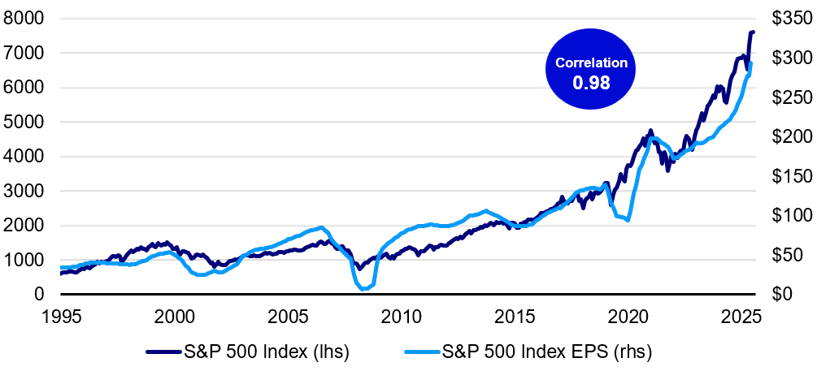
Source: Bloomberg, Factset, Shiller database as at 31 May 2026.
Volatility in the technology/AI sector is, however, undeniably high and the outlook for central bank policy remains particularly opaque. This has driven our recent moves to further diversify risk by allocating more capital into alternatives (and diversifying what we hold within the sector). It is also the reason we have adopted a relatively defensive positioning in fixed income and have been adjusting our underlying equity holdings to ensure we are significantly less concentrated than global indices in terms of our country and sector positioning.
If you would like to learn more about Bordier UK or have any questions regarding this briefing, please contact a member of the team.
This page is issued and approved by Bordier & Cie (UK) PLC (‘Bordier UK’). Incorporated in England No: 1583393, registered address 23 King Street, St James’s, London, SW1Y 6QY. The company is authorised and regulated by the Financial Conduct Authority (‘FCA’).
Bordier UK is a wealth and investment manager dedicated to providing portfolio management services. We offer Restricted advice as defined by the FCA, which means that if we make a personal recommendation of an investment solution to you, it will be from Bordier UK’s range of investment propositions and will reflect your needs and your approach to risk.
This page is not intended as an offer to acquire or dispose of any security or interest in any security. Potential investors should take their own independent advice to assess the suitability of investments. Whilst every effort has been made to ensure that the information contained in this page is correct, the directors of Bordier UK can take no responsibility for any action taken (or not taken) as a result of the matters discussed within it.